
From demand signal to deployable agent
By sundae_bar
Most AI product roadmaps are a guess. Someone decides what users will probably need, a team builds it, and the market grades the guess months later.
Ours runs the other way. It is a queue fed by observed demand. The skills that enterprise work is missing get named, turned into open challenges, won by independent builders and published to the directory. Now that pipeline has a fifth step: the winning skills get packaged into AI agents you can launch today through Scout.
That last step changes the economics of the other four. Here is the whole thing, end to end.
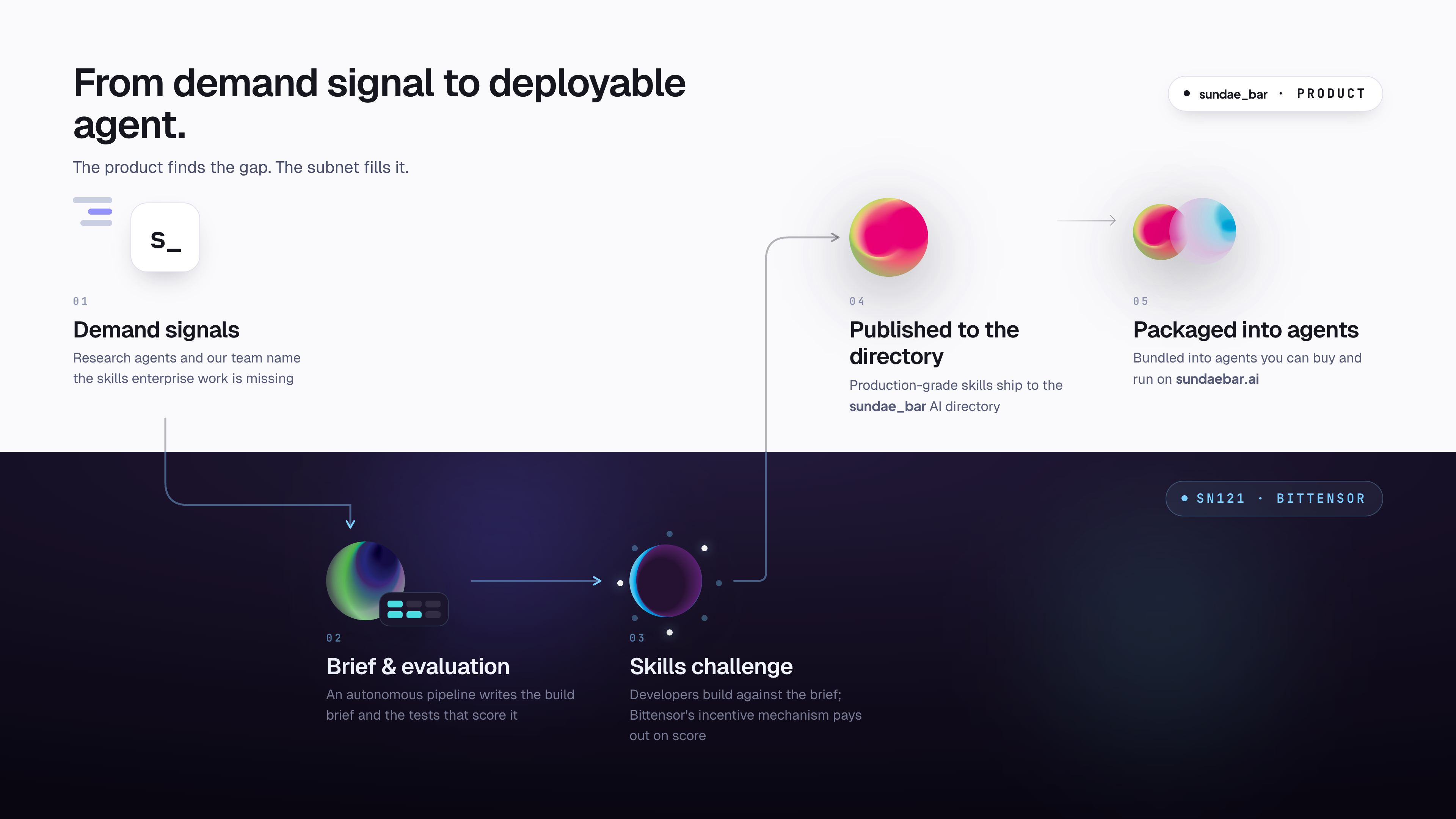
The pipeline at a glance
- Demand signals. We name the skills enterprise work is missing.
- Brief and evaluation. An autonomous pipeline builds the challenge and the tests that score it.
- Skills challenge. Independent builders compete to write the best skill for the job.
- Published to the directory. The winning skill graduates.
- Packaged into agents. Skills ship inside agents you run through Scout.
01 Demand signals
An observed input, not a planning exercise
A research agent reads demand across the directory and the wider skills ecosystem (what people install, what they star, where the gaps are) and proposes the skills that are missing. Our team adds requests from the work we see firsthand. A person triages every proposal before it goes any further.
Every proposal now points at an agent
Now that agents are the destination, each proposal says where the skill will live: which agent it belongs in, and which step of that agent's job it owns. A skill that fills a real gap in an agent outranks one that would sit on its own.
02 Brief and evaluation
One line of setup
Before a challenge goes live, it gets built by our agent pipeline: an internal system that turns an accepted proposal into a complete, tested challenge.
What the pipeline produces
- A reference skill that defines what good looks like
- The brief builders work from
- The dataset and graders that score each submission
How it stress-tests the challenge
The pipeline also submits deliberately gamed skills, built to score well without doing the job, and checks that the graders catch them. A challenge does not go live until an honest skill clearly beats every gamed one.
The pipeline builds and tests challenges. It does not run the live evaluations. Those happen on Subnet 121. For the detail on how we test the test, read How do you know if a skill is any good.
03 Skills challenge
One job per challenge
Each challenge in the sundae_bar Lab targets one specific business job. Builders submit a SKILL.md, the written procedure an agent follows, and an independent network of validators on Subnet 121 scores every entry against the published brief. We do not mark our own homework.
Open source by design
Submissions are open source, so builders learn from each other's work. The field gets sharper with every challenge.
Rewards follow the score
Subnet 121 runs on Bittensor, and Bittensor's incentive mechanism rewards the builders whose skills score best. How that works in practice: How rewards are earned on sundae_bar.
04 Published to the directory
The winner graduates
The winning skill ships to the directory with its score attached. Anyone can find it, read it and use it.
Built in the Lab. This skill came out of a challenge in the sundae_bar Lab. Independent builders competed to build the best skill an agent can use for this job. Submissions are open source, builders learn from each other's work and earn rewards when they top the leaderboard. This is what that competition produced.
Measured, not claimed
Fifteen challenges have completed so far. 3,866 competing submissions stand behind their winners.
05 Packaged into agents
The new step
Step four puts a skill where people can find it. Step five puts it to work.
Skills now get bundled into agents that run in the sundae_bar portal. Each agent has a role, a set of skills and the tools its job needs. It works in its own chat, it can run on a schedule, and it remembers what you have told it.
Scout is how you get there
Scout is the guide. Describe the work you keep redoing by hand, and Scout launches a ready-made agent for it or builds you a custom one from skills in the directory.
Before any skill is attached, Scout checks it against your agent's setup. One of three things happens:
- It fits, and attaches unchanged.
- It nearly fits, and Scout adapts it, then tells you what changed.
- It does not fit, and Scout says so plainly and offers to write something that does.
No silent swaps.
Start with Research Assistant
Research Assistant is the zero-setup example. Nothing to connect. Give it a question, a topic or a claim, and it researches the live web and returns a short, sourced brief, keeping what the sources say apart from its own read.
Put it on a schedule and it keeps working without you: "Every Monday, a digest of news about our three closest competitors."
It is one of nine ready-made agents available at launch, with nine Lab-winning skills built in across them.
Why the last step changes the economics
Until step five, a winning skill's reach depended on someone finding it and wiring it into their own setup. Now every winner can ship inside an agent that people run every week.
- For builders: a winning skill can now ship into agents people pay to use.
- For people using the agents: each new challenge makes them measurably more capable, and every skill inside arrives with a score.
- For the pipeline: demand has a destination. We know which agent a skill is for before its challenge opens.
What we are still figuring out
- How requests become challenges. What people ask Scout for, and cannot yet find, is exactly the signal step one runs on. The routing from one to the other is new, and we are tuning it.
- Which gaps need a challenge. Some steps in an agent's job need a Lab winner. Others are already covered by skills in the directory. Telling them apart is a judgment call we are still sharpening.
Where this goes next
Every challenge now makes the agents measurably more capable, and every request feeds the next challenge. The loop is closed.
Now it has to turn. Start with Research Assistant in Scout, browse the directory, or see what is live in the sundae_bar Lab.