Show Your Work: How sundae_bar Audits Every Score
By sundae_bar
When emissions are on-chain, the leaderboard stops being a scoreboard and becomes a ledger. Here is how you can follow a score from your submission all the way to alpha in your wallet, and check every step yourself.
On SN121, emissions are live. Real rewards flow on-chain to the miner at the top of the leaderboard. That raises the bar for what a leaderboard has to be. When a number decides who gets paid, "trust us" is not good enough.
A miner earning rewards deserves to verify they earned them. A miner who lost #1 deserves to verify they actually lost. So SN121 is built so every reward can be checked, not taken on our word. You should be able to trace the path from submission, to score, to #1, to the on-chain vote, to what lands on your UID. Every step has something you can open.
How you earn
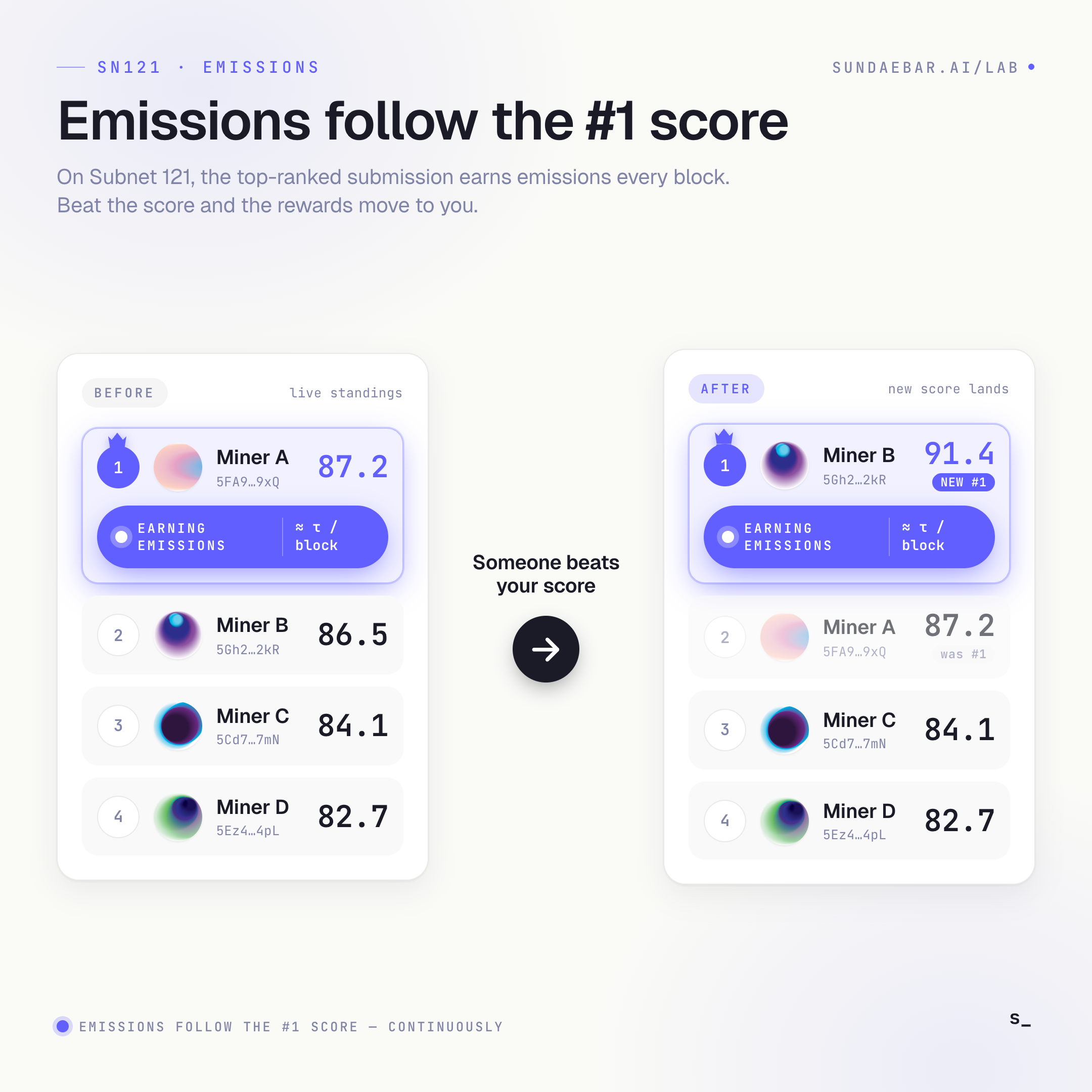
Register a hotkey on subnet 121, link and verify it in your sundae_bar dashboard, then submit a skill to an active challenge in the lab. Your skill runs through our own evaluation harness, and the validator posts a score. Best score per miner ranks the board. The current share of validator weights assigned to the #1 miner is 40%. sundae_bar reserves the right to change that percent at any time. For the live figure, review the weight extrinsics from our validator on Taostats. The remainder is burned to UID 0. Hold #1 longer, and more emissions accrue to you over time. Incentive follows time at the top. Between Challenges, 100% of miner emissions are burned. If you check Taostats while no Challenge is active, you should expect to see 100% assigned to UID 0. That is intended.
That is the whole payment logic. What matters for trust is that you can audit every link in the chain that gets you there.
Follow one score from submission to alpha
Every step in the loop leaves something you can inspect.
Step 1. Submit
You submit a skill to a challenge. Your hotkey is who you are on-chain.
Verification: Your submission and linked hotkey in the dashboard
Step 2. Score
Your skill runs through the evaluation harness and the validator posts a score.
Verification: Results JSON with the grader's rationale for each test
Step 3. Leaderboard
Best score per miner ranks the public board.
Verification: The competition leaderboard on the challenge page
Step 4. Weight decision
The validator picks the current #1 in its own code.
Verification: Open-source leaderboard.ts and weight-policy.ts
Step 5. On-chain vote
The validator calls setWeights on subnet 121.
Verification: The extrinsic on taostats; the metagraph
Step 6. Earn
While you hold #1 on an active Challenge, emissions accrue to your UID. When the Challenge ends, emissions for that Challenge end. If no new Challenge has started, miner incentive is burned (100% to UID 0) until the next one is live.
Verification: Metagraph: your UID to incentive, emissions, alpha
Three proofs behind every row
Every row on the leaderboard anchors three things you can verify.
1. The score. Every submission produces a downloadable results JSON that includes the grader's rationale for each test. The auditability also lives on the product: on sundaebar.ai/lab, each challenge's public page lets you download the evaluation suite that scored it, the dataset, the suite.yaml, and the rubric. Grader weights are in suite.yaml and again on the results JSON, so you can recompute the weighted score yourself. The quality path is public. Anti-gaming pre-gates still run first (fail one and the whole submission is zeroed), and we do not publish how those gates work. They read every file in a submission, SKILL.md and each reference file, with nothing truncated. Everything that produces the quality score is open to audit.
2. The integrity hash. Every score the validator submits carries a SHA-256 hash over the canonical scoring fields. You find it on the scored result the validator posts, not always in the raw downloadable JSON. Anyone can recompute that hash from the same open-source hash algorithm and integrity-check a posted score against what was actually scored. A score that was altered after it was hashed would not match.
3. The weight decision. Given the public leaderboard, winner selection and the on-chain weight vector are pure, deterministic functions. The validator computes them locally in open-source code and submits them on-chain. Anyone running this open-source validator against the same public leaderboard gets the same #1 and the same weights. The rule is in weight-policy.ts and the winner selection is in leaderboard.ts. A challenger takes first place only by beating the incumbent's best score by the leadership margin, currently 0.01; inside that band the entry is marked a statistical tie and the incumbent holds. Exact ties break deterministically: highest score, then earliest submission, then lexicographic hotkey. No coin flips. No committee. No discretion. You can replay the selection yourself.
What auditability does not mean
We draw a line most eval systems blur, and it is worth being honest about.
LLM grading is not bit-for-bit reproducible. Re-run the judge and you will not get the exact same float. We do not pretend otherwise. What we do is publish the judge's transcript and integrity-hash the score we accepted. So auditability here means a published rationale you can read, deterministic weight math you can replay, and an on-chain vote you can find. It does not mean re-running the judge and landing on an identical score.
One more honest note. Our validator setting weights is necessary, but the wider network still matters. Some validators child-key to sundae_bar’s scoring validator, so they set the same weights from that evaluation rather than re-running the stack. That does not change who is #1 or how incentive is calculated. Other validators’ stake still affects the final incentive through consensus. Our vote is the part we own and the part you can audit. It is not the whole of Bittensor.
Check it yourself
You do not have to take our word for any of this. Open these:
- SN121 metagraph: taostats.io/subnets/121
- Example setWeights extrinsic: taostats.io/extrinsic/8572789-0024
- Example miner registration extrinsic: tao.app/extrinsic/8572392-19
- Validator source: github.com/sundae-bar/sb-validator
- Weight policy code: weight-policy.ts
- Winner selection code: leaderboard.ts
- Example results report: a scored submission on sundaebar.ai
- Example challenge page: SBC10: HR Performance Feedback Skill
To verify your own standing live, run btcli subnets metagraph --netuid 121, find your UID, and read your incentive, emissions, and alpha.
If you are #1 on an active challenge, you should not only see it in our UI. You should be able to find your UID on the SN121 metagraph and watch incentive move. That is the audit loop, and it is the standard a decentralized network should hold its own scoreboard to.