
sundae_bar explained: how we build AI agents, and how SN121 makes them better
By sundae_bar
Most enterprise AI agents get built the wrong way round. A team builds a capability, decides it is impressive, and then goes looking for the business that needs it. The result is a long tail of AI products that work exactly as designed and solve a problem nobody had.
sundae_bar builds in the opposite order. The requirement comes first. The agent is assembled from skills that existed because someone needed them.
We made a one-minute video that follows the whole loop, from a customer describing a job in plain language all the way back to the competition that produced the skill they ended up using.
What the customer actually does
The video opens where a customer opens: a search bar and a description of a real Monday. Someone writes the same project update three times a week, once for the team, once for partners, once for exec review, and it costs them a morning.
They do not choose a model. They do not choose a framework. They describe the outcome they want, and Scout finds the skills that do that job and packages them into an agent. It runs, and it returns all three versions.
That is the part most AI companies show. The interesting part is what has to be true behind it for that to work.
Where the requirement comes from
What gets built next on sundae_bar is decided by evidence, not by a roadmap meeting.
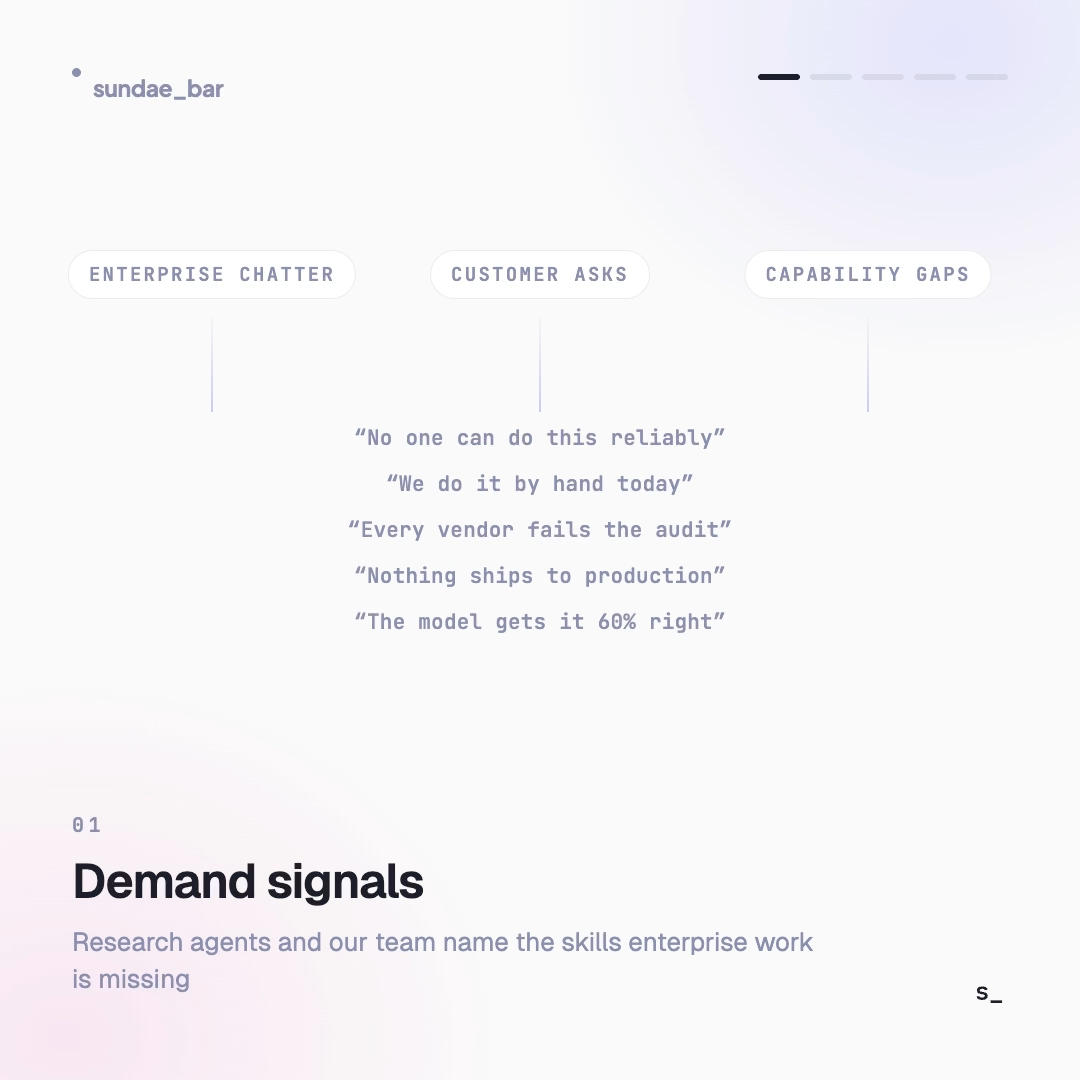
The demand signal is assembled from what people are actually looking for:
- Search activity on sundaebar.ai, which is a direct record of capabilities customers came looking for and did not find
- Public signal from LinkedIn, Reddit and GitHub, where the same gaps get described in the open
When a capability shows up repeatedly, it stops being an observation and becomes a requirement.
From requirement to challenge
A requirement on its own is not something a developer can build against. It has to become a brief with success criteria, and an evaluation suite that can tell a good answer from a plausible one.
An internal agent pipeline does that work. It turns the signal into a scoped brief, builds the dataset and the graders that will score submissions, and stress-tests the whole thing before anything goes live, including submitting deliberately gamed skills to confirm the graders catch them. Two human checkpoints sit on the chain.
The pipeline builds the challenge. It does not score the live submissions. That happens on the subnet.
Open competition decides what ships
The challenge goes live in the sundae_bar Lab, which runs on Subnet 121 on Bittensor.
Independent builders submit a single file, a SKILL.md. sundae_bar supplies the base agent, so the competition is on skill quality and nothing else. Submissions are open source, which means builders can read each other's work and the next round starts from a higher floor than the last one.
Every submission is scored against the same test. Validators do the scoring, the leaderboard is public, and top scores earn rewards.
Then the part that matters most: the skill ships only when it clears the production bar. Winning a leaderboard is not the same as being ready for a customer, and a challenge that never clears the threshold produces no listing.

The loop closes
The skill lands in the directory. The next customer who describes that job gets an agent assembled from it, and never has to know any of the above happened.
Business requirement, challenge, open competition, scored submissions, a skill that clears the bar, a customer outcome. Then the outcome generates the next requirement.
Why this compounds
A traditional AI company improves its product at the speed of its own engineering team. Adding capability means adding headcount.
sundae_bar's supply is not bounded that way. More customers produce a clearer picture of what businesses need. Clearer requirements produce better challenges. Better challenges attract stronger submissions. Stronger submissions expand what the platform can do, which serves more customers.
The ambition is a platform that gets more capable without the engineering team growing in proportion.
What this is not
It is not a model where sundae_bar stops building. sundae_bar builds the generalist agent, the evaluation infrastructure that improves it, and its own products. Open competition supplies skills. It does not replace the company that decides what is worth competing over.
That decision is the whole thesis. Anyone can run a competition. Running the right competition, on a requirement a business already has, is the harder half.
The next challenge is already being written from this week's signal.